Tech,Space,Gaming, and Science Fiction News to wet your whistle
A $1,500 smart mirror brings live fitness classes to your home
Get link
Facebook
X
Pinterest
Email
Other Apps
Fitness apps aren't anything new, but none of them can really replicate how it is to be in a class, with the instructor encouraging you in real-time or helping you out if you can't quite do those push ups. Mirror, however, aims to do for fitness classes what Peloton did with the cycling class: bring a live instructor into your home. And it does all this with a full-size mirror.
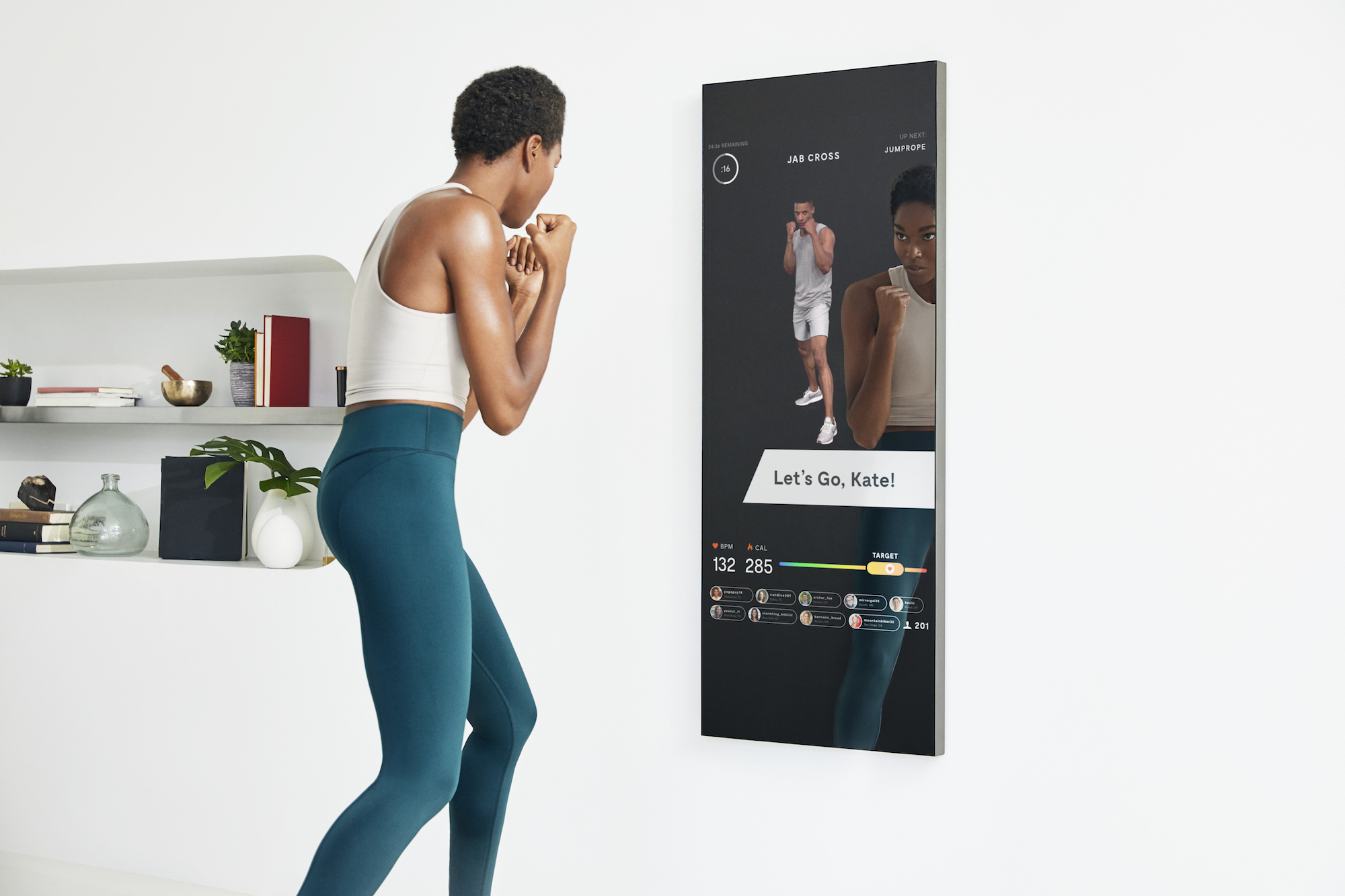
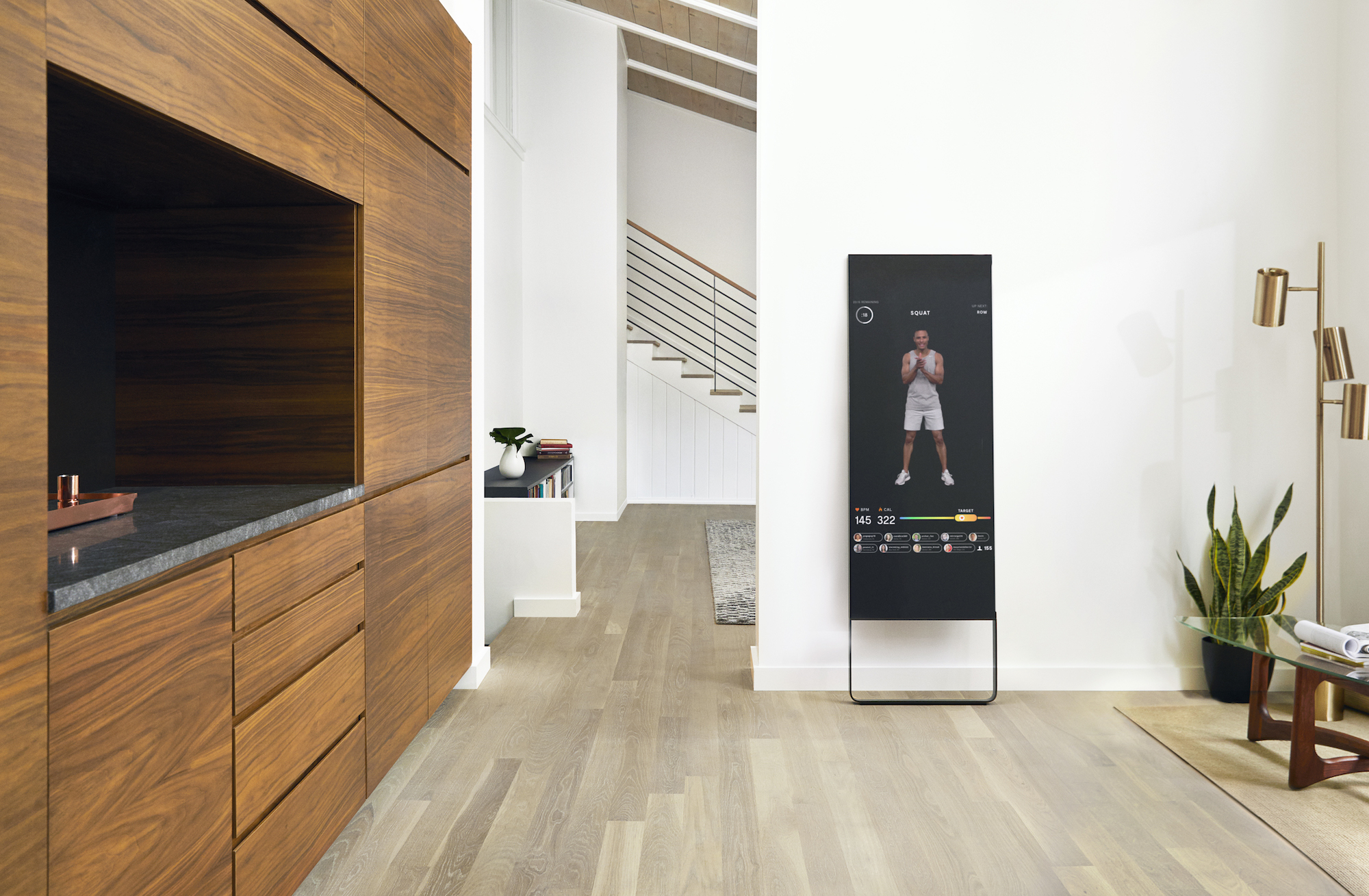
Of course, Mirror isn't an ordinary mirror. It looks just like one when it's turned off, measuring 22 inches wide, 52 inches high and a little over an inch deep. But embedded inside its large frame is actually a vertical LCD panel and stereo speakers, which come to life when it's switched on. You can then control what's on the Mirror via a companion app.
I took a peek at an early prototype of Mirror with founder and CEO Brynn Putnam, and an assistant outfitted in workout clothes was there to demonstrate it for me. On Mirror's screen was a video of the instructor, streamed live from a studio in New York City. She talked through a variety of different moves, like squats, burpees and lunges, in what was a high-intensity interval training class.
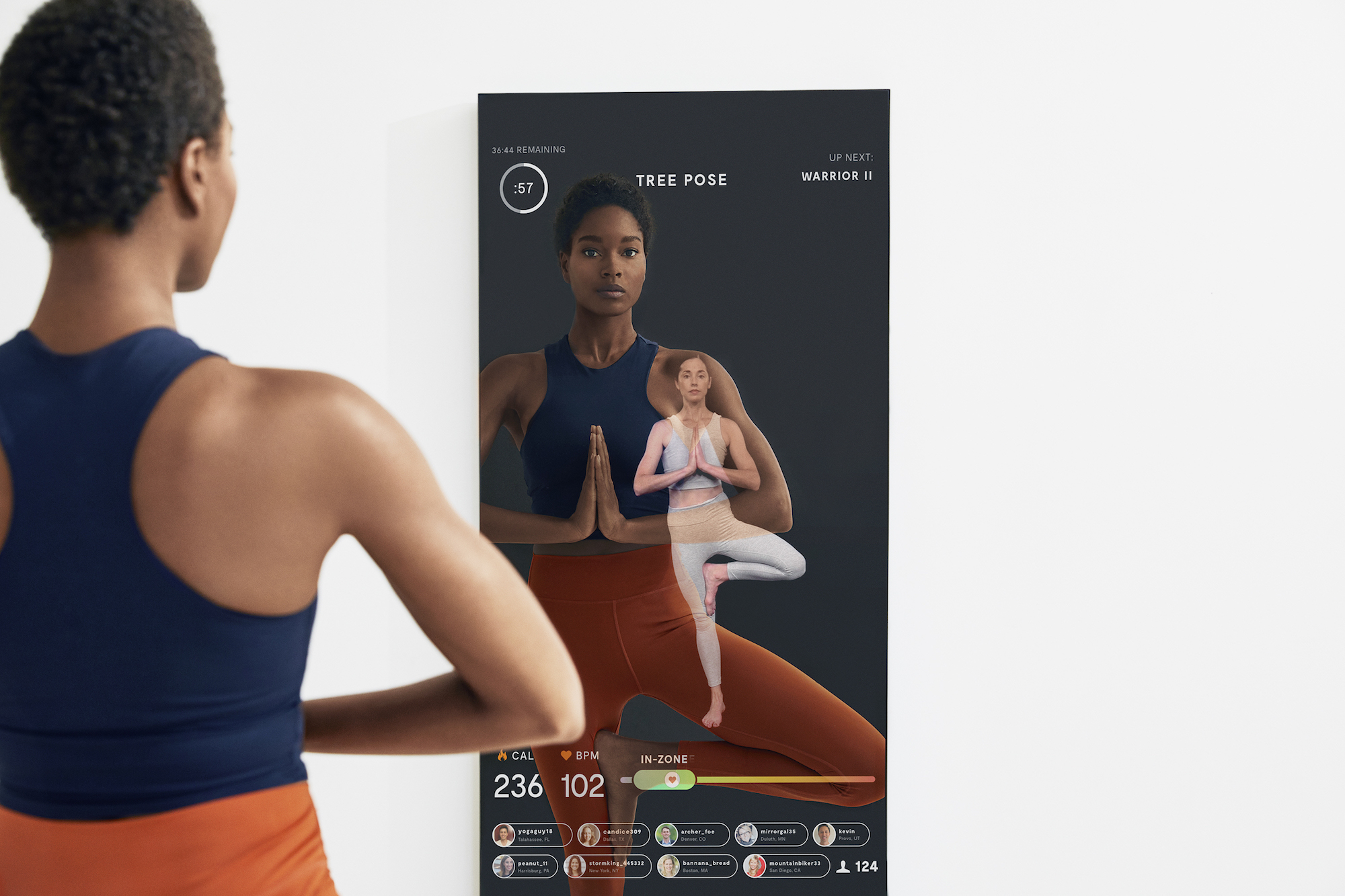
Because the assistant had a heart rate monitor on, we could see her beats-per-minute on screen, as well as her target heart rate zone. You have the option of pairing your Apple Watch to track your heart rate if you so desire. Also on the display were calories burned, the amount of time left in the workout, and the names of a few people who were taking the class at the same time. During the class, the instructor occasionally offered personal shout-outs or encouragement.
Interestingly, because it's a mirror, you can still see a reflection of yourself while the class is taking place. This is intentional. Putnam, a professional dancer by training, says that it's actually really helpful to see yourself doing the workout while it's happening. "Sometimes you don't know your shoulders are hunched until you actually see it," she said. It also helps for making sure you have the right posture and form.
One of Mirror's features that sets it apart from normal fitness apps is personalization. You can specify in your profile that you have a bad knee, for instance, so instead of doing the jumps on screen, you're offered an alternate workout, such as squats, that appears off to the side.
Once you're in the swing of things, Mirror will recommend other classes to try out depending on your performance. Classes at launch include cardio, strength, yoga, Pilates, barre, boxing and stretch, with about five difficulty levels. So if you frequently hit your target goal, you might be encouraged to try out a more challenging class. Or if you didn't hit your goals at an expert level, it would recommend you try an intermediate or beginner class instead. Beginner classes tend to be slower and more deliberate, said Putnam, while expert classes are more fast-paced.
Though Mirror didn't mention Peloton specifically in its release, the model is similar. One of the reasons Peloton took off is that it brought the cycling class to the home. No longer need you spend hundreds of dollars a month to go for a spin on a studio's schedule; you could now do so in your own living room and on your own time. Yet, not everyone wants a bike -- or even a large treadmill -- taking up space in their abode. Plus, cardio machines effectively offer a limited kind of workout, and you might tire of cycling or running eventually. With Mirror, Putnam said, there's more variety in the kinds of classes you can take.
Another bonus with Mirror is an option for personal training. There're a microphone and camera built-in to the hardware, which allow for one-on-one training sessions with a certified personal trainer, where they can see you and guide you through customized workouts. They cost anywhere from $40 to $75 per session, depending on the expertise level of the trainer.
Yet, there's a cost to all of this. The Mirror hardware is priced at a whopping $1,495 and the subscription cost is $39 a month. I asked Putnam if there were plans to sell an option that didn't require the hardware, but there are none at this time. Which is a shame, because I think Mirror is actually a pretty good idea, and I love that it can personalize workouts for you. But as I mentioned earlier, fitness class apps are a dime a dozen these days. Even Peloton offers optional floor exercise classes like yoga and bootcamp in addition to the cycling. DailyBurn has a similar live streaming workout plan for only $20 a month, no hardware required. Sure, it's not quite as personalized and there's no option for personal training, but not everyone has a spare $1,495 to burn either.
But hey, if you do, then you might want to give Mirror a shot. It's making its public debut today at TechCrunch Disrupt in San Francisco if you want to take a look at it, or you can order it right now from Mirror's website.
By Liam McCabe This post was done in partnership with Wirecutter . When readers choose to buy Wirecutter's independently chosen editorial picks, it may earn affiliate commissions that support its work. Read the full article here . After six summers of researching, testing, and recommending window air conditioners, we've learned that quiet and affordable ACs make most people the happiest—and we think the LG LW8016ER will fit the bill in most rooms. This 8,000 Btu unit cools as efficiently and effectively as any model with an equal Btu rating, and runs at a lower volume and deeper pitch than others at this price. Little extra features like a fresh-air vent, two-axis fan blades, and a removable drain plug help set it apart, too. The LG LW8016ER is a top choice for an office or den, and some people will find it quiet enough for a bedroom, too. If our main pic...
Currently priced at: 14.69 via https://ift.tt/HzrCcJa May 4, 2022 at 07:00PM Manage Unsubscribe from these notifications or sign in to manage your Email service. ...
Pre-loaded cartridges of cannabis concentrate are currently among the most popular means of consumption, and for good reason. They're discreet to use and easy to handle, a far cry from the dark days of 2016 when we had to dribble hash oil or load wax into narrow-mouthed vape pens by hand. But, frustratingly, an ever increasing number of oil cartridge manufacturers employ one-off design standards so that their products won't work with those of their competitors, thereby locking customers into proprietary ecosystems. We've already seen this with nicotine vaporizers -- which has a seen a massive rise in "pod systems" in the last few years, each outfitted with a unique canister and battery built to be incompatible with those of their competition. Is it too late for the burgeoning cannabis industry to set a universal standard for their product designs? ...





Comments
Post a Comment